Introduction
Walk through any busy hospital ward in India, and the signs are unmistakable. Nurses are stationed behind overflowing files. Doctors flipping through handwritten case sheets to find yesterday's lab result. Billing staff manually cross-referencing treatment records before generating a discharge summary. This scene, familiar across hundreds of hospitals from Tier 1 cities to Tier 2 towns, represents a systemic challenge that costs hospitals far more than the price of paper.
Inpatient care is the most complex and resource-intensive function a hospital manages. A single admitted patient generates documentation across nursing shifts, doctor rounds, pharmacy orders, diagnostic reports, consent forms, and discharge instructions. When this documentation happens on paper, the risks multiply: illegible entries, misplaced files, delayed decisions, and audit gaps. The administrative burden on clinical staff grows, and the patient experience suffers in ways that are difficult to measure but impossible to ignore.
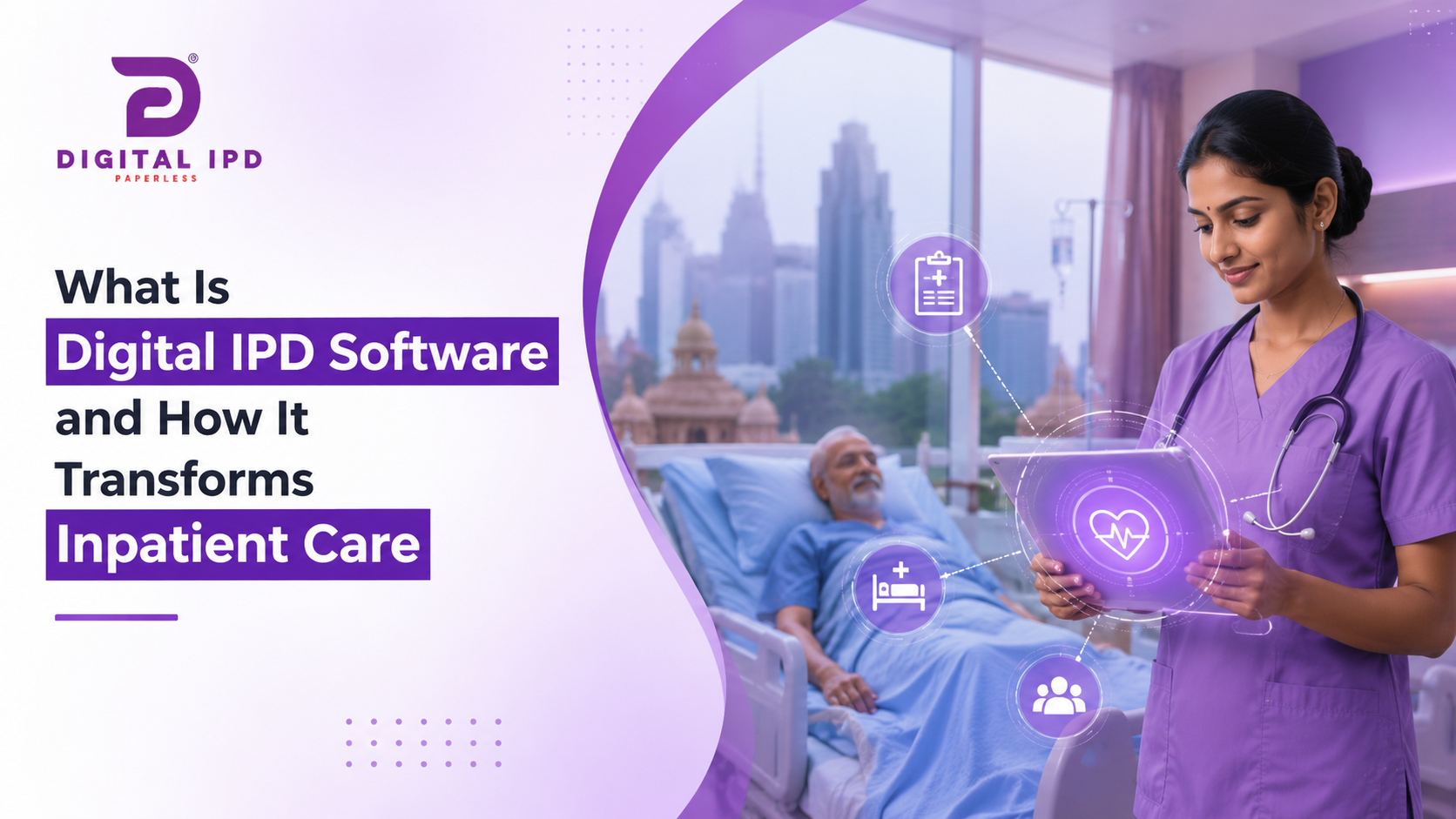
Digital IPD software addresses this challenge at its root. It is not simply a digitisation tool that converts paper forms into PDFs. It is a connected bedside documentation and inpatient coordination platform that brings structure, speed, and clinical reliability to the entire inpatient journey. For hospital leaders, nursing heads, and quality teams evaluating how to modernise their operations, understanding what Digital IPD software is and how it works is the essential first step.
Understanding What Digital IPD Software Actually Is
Digital IPD software is a purpose-built platform designed to manage the documentation and coordination needs of an Inpatient Department from the moment a patient is admitted until the moment they are discharged. Unlike a general Hospital Management System that covers the entire hospital ecosystem, Digital IPD software focuses specifically on the inpatient journey and the clinical workflows that define it.
At its core, the platform replaces the physical patient file with a structured digital record that every authorised team member can access in real time. Doctors completing their ward rounds, nurses updating vitals at the bedside, pharmacy staff verifying medication orders, and billing teams preparing discharge invoices all work from the same live patient record rather than passing physical files back and forth across departments.
The platform typically operates on cloud-based infrastructure accessible through tablets, bedside workstations, or mobile devices, making it practical for deployment across wards, ICUs, and nursing stations without requiring significant hardware investment. In the Indian hospital context, where Android-based tablets have become widely adopted, Digital IPD software is designed to run on accessible hardware without demanding high connectivity or expensive on-premise servers.
What distinguishes a well-built Digital IPD solution from a basic electronic record system is its understanding of how Indian hospital workflows actually function. Shift handovers, consultant visits, nursing care plans, NABH-oriented documentation standards, MRD requirements, and TPA billing integration are not afterthoughts. They are built into the platform's core logic.
The Core Components That Define a Digital IPD Platform
A complete Digital IPD software platform covers several interconnected documentation and workflow layers that together replace the paper-based IPD file.
Admission and Patient Registration
The inpatient journey begins at admission. Digital IPD software captures patient demographics, admission history, presenting complaints, and bed allocation in a structured digital form. This information flows automatically into every subsequent module, eliminating the need for repetitive manual data entry across departments.
Bedside Nursing Documentation
Nursing documentation is the largest volume of paperwork generated in any IPD. Vital signs, nursing notes, medication administration records, fluid balance charts, wound care records, and shift summaries all demand structured and consistent recording. Digital IPD software enables nurses to document at the point of care using bedside devices. Every entry is timestamped and attributed to the recording staff member, creating an accurate and auditable clinical record.
Doctor Progress Notes and Clinical Orders
Physician documentation in a traditional IPD includes daily progress notes, investigation orders, medication prescriptions, and procedure records, all handwritten and often difficult to read under time pressure. Digital IPD software provides structured templates for doctor notes that preserve clinical detail while ensuring legibility and completeness. Investigation orders and prescriptions flow directly to the relevant departments, reducing turnaround time and the risk of transcription errors.
Vitals Monitoring and Trend Tracking
Rather than recording vital signs on separate paper sheets that must be manually reviewed, Digital IPD software captures vital data in a format that generates trend charts automatically. This gives clinicians a visual picture of a patient's condition over time, supporting faster and more informed clinical decision-making.
Consent Management and MRD Documentation
Consent forms, discharge summaries, and Medical Records Department documentation represent some of the most compliance-sensitive paperwork in any hospital. Digital IPD software digitises consent collection, links it to the patient record, and ensures that discharge summaries are generated from live clinical data rather than assembled manually at the point of discharge.
Discharge Workflow Management
Discharge delays are a persistent operational challenge for Indian hospitals, often caused by the time required to prepare billing summaries and clinical documentation simultaneously. A connected Digital IPD platform allows discharge summaries to be built progressively throughout the patient's stay, so that by the time the clinical team approves discharge, the documentation is substantially complete and the billing reconciliation can happen within minutes rather than hours.
How Digital IPD Software Transforms Inpatient Care Operations
The transformation that Digital IPD software brings to an inpatient department operates on several levels simultaneously: clinical efficiency, nursing productivity, coordination between departments, compliance readiness, and patient experience.
Eliminating the Hidden Cost of Paper-Based Workflows
The cost of paper-based IPD management is rarely calculated honestly. Beyond the expense of printing and physical storage, the real cost lies in clinical time diverted to documentation, in treatment delays caused by unavailable records, and in billing errors that result from manual charge reconciliation. A 100-bed hospital operating on paper systems can easily lose significant productive hours daily across nursing, administration, and billing functions to tasks that a digital system would complete automatically.
Improving Clinical Coordination Between Doctors and Nurses
In a paper-based system, the clinical handover between shifts depends on a physical file and a verbal briefing. Information gets filtered, details get missed, and the new shift begins without a complete picture of the patient's status. Digital IPD software creates a continuous, shared record that the incoming nursing shift accesses immediately with full context. Doctors arriving for rounds see updated vitals, pending investigations, and nursing observations from the previous shift without needing to review handwritten notes or speak directly to the outgoing nurse before seeing the patient.
Supporting NABH Compliance and Audit Readiness
The National Accreditation Board for Hospitals and Healthcare Providers has increasingly aligned its standards with digital documentation expectations. NABH's Digital Health Standards framework, alongside the broader NABH accreditation requirements, emphasizes structured clinical records, complete nursing assessments, tamper-proof audit trails, and standardised documentation formats. Digital IPD software supports these requirements by design. Nursing assessments, including nutritional risk, fall risk, and pressure ulcer screening, are completed in standardised digital forms. Every clinical entry carries a timestamp and a user attribution. The system eliminates the documentation gaps that paper-based processes routinely create under audit scrutiny.
- Standardised digital forms remove variability in nursing assessments
- Timestamped entries create a reliable audit trail for every clinical decision
- Real-time record access means information is current rather than retrospectively updated
- Discharge summaries draw from documented data, reducing the risk of post-discharge record reconstruction
Strengthening the Patient Experience
Patient experience in an IPD setting is shaped largely by how organized and communicative the clinical team appears. When nurses spend less time on paperwork, they spend more time at the bedside. When doctors arrive for rounds with full access to a patient's current status on a tablet, consultations are more focused and informative. When discharge happens in minutes rather than hours because the documentation is already complete, patients and families leave with a better impression of the hospital's operational capability.
Enabling Faster Discharge and Better Bed Utilisation
Bed utilisation is a critical operational metric for any hospital. Discharge delays directly reduce the number of admissions a hospital can accommodate, affecting both revenue and care capacity. Digital IPD software accelerates discharge readiness by ensuring that clinical documentation and billing information are built concurrently throughout the patient's stay. When the treating doctor clears a patient for discharge, the system can generate a draft discharge summary and consolidated bill almost immediately, reducing the average discharge processing time significantly.
Why Indian Hospitals Are Moving Toward Digital IPD Solutions
India's healthcare sector is undergoing a structural shift driven by several converging factors. The adoption of Ayushman Bharat PM-JAY and state health insurance schemes has increased insurance-linked admissions significantly, making accurate and complete documentation a financial necessity rather than merely a compliance preference. Hospitals that cannot produce organised, legible, and complete inpatient records face claim rejections and delayed reimbursements from TPAs and government schemes.
The Ayushman Bharat Digital Mission (ABDM) has further accelerated digital adoption by creating a national framework for linked health records and digital patient identifiers. Hospitals investing in Digital IPD infrastructure are better positioned to participate in this ecosystem, linking admission records to ABHA-based patient profiles and enabling smoother data exchange with insurers and government health programs.
Beyond policy drivers, the practical pressure of managing rising patient volumes in both metro and Tier 2 city hospitals has made paper-based systems increasingly untenable. Hospitals in cities like Kota, Nagpur, Coimbatore, and Bhubaneswar, which have seen significant growth in secondary and tertiary care capacity, are evaluating Digital IPD solutions as a core operational upgrade rather than an optional technology investment.
Selecting the Right Digital IPD Platform for a Hospital
Not every digital documentation tool qualifies as a true Digital IPD platform. Hospital decision-makers evaluating options should look for systems that offer genuine integration between clinical documentation and operational workflows rather than standalone form digitisation.
Key considerations include whether the platform supports bedside documentation on standard tablet hardware, whether it connects with the hospital's existing billing and pharmacy modules, whether it is built with NABH documentation standards in mind, and whether the implementation partner has experience with real hospital workflow requirements rather than only software deployment.
A platform built on genuine healthcare IT experience, with deep familiarity with Indian hospital operations, will provide not just a technology product but a structured implementation pathway that respects the realities of clinical workflows, staff training requirements, and phased adoption timelines.
Digital IPD, developed by Caresoft Systems, represents exactly this kind of purpose-built bedside documentation experience. Built on Caresoft's long-standing healthcare IT expertise, it is designed for hospitals that want to modernise their inpatient operations in a connected, practical, and clinically grounded way without disrupting the core HIS ecosystem they already depend on.
Conclusion
Digital IPD software is not a technology trend. It is a clinically necessary evolution for hospitals that want to deliver organised, safe, and efficient inpatient care in a landscape where documentation standards, insurance requirements, and patient expectations are all rising simultaneously.
The transformation it enables is practical and measurable: less time spent on paperwork, more time available for patient care, structured clinical records that hold up under audit, faster discharge processes, and a connected bedside experience that brings doctors, nurses, billing teams, and MRD staff into alignment around a single shared patient record. For hospital owners, medical directors, nursing heads, and quality teams who understand that the next step in their institution's growth depends on stronger operational foundations, Digital IPD software represents a clear and achievable path forward.
The hospitals that invest in connected bedside documentation today are not simply digitising their processes. They are building the clinical and operational infrastructure that will define premium inpatient care in India for the decade ahead.
Frequently Asked Questions
Q1: What is Digital IPD software?
Digital IPD software is a connected bedside documentation and inpatient care coordination platform that replaces paper-based IPD processes with structured digital workflows. It manages everything from patient admission to discharge, including nursing notes, doctor observations, vitals tracking, consent forms, and MRD records, all from a single integrated system.
Q2: How does Digital IPD software help hospitals achieve NABH compliance?
Digital IPD software supports NABH compliance by ensuring that all nursing assessments, clinical records, medication charts, and consent forms are captured in standardised digital formats with timestamps and audit trails. This eliminates gaps caused by handwritten documentation and ensures hospitals are audit-ready at all times without the need for last-minute file preparation.
Q3: Can Digital IPD software work alongside an existing Hospital Information System?
Yes. Digital IPD software is designed to integrate with existing Hospital Information Systems without disrupting core workflows. It connects bedside documentation with billing, pharmacy, laboratory, and MRD modules while allowing hospitals to upgrade their inpatient operations incrementally rather than replacing their entire technology ecosystem.
Q4: What are the benefits of Digital IPD software for nursing staff?
Nursing staff benefit through reduced documentation time, elimination of repetitive handwriting, real-time access to patient records at the bedside, digital medication charts with alerts, and structured shift handover records. This allows nurses to spend more time on direct patient care rather than administrative paperwork.
Q5: Is Digital IPD software suitable for mid-size hospitals in India?
Digital IPD software is particularly well-suited for mid-size hospitals in India that want to modernise their inpatient documentation without the complexity and cost of a full enterprise HIS replacement. It offers phased implementation, role-based access, and cloud-based infrastructure that scales with hospital size, making it practical for hospitals ranging from 30-bed nursing homes to 300-bed multi-speciality facilities.