Introduction
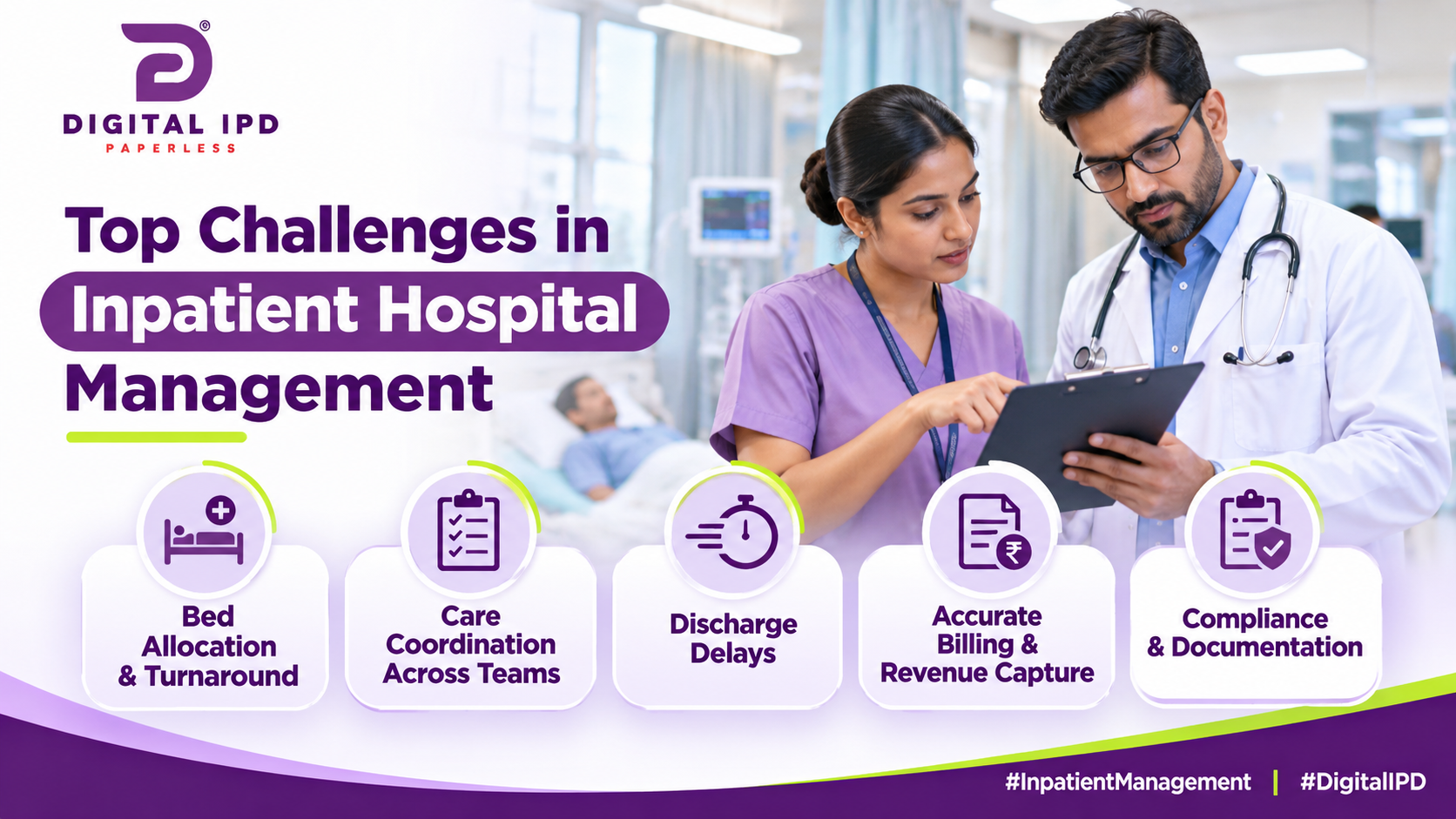
Inpatient hospital management sits at the center of everything a hospital does. When a patient is admitted, every decision made from that moment onward depends on how well the hospital's internal systems work together. Nursing workflows, doctor documentation, bed allocation, treatment coordination, discharge processes, and medical records all move in parallel, and any weakness in this chain affects patient safety and operational efficiency.
Hospitals across India, whether multispecialty institutions in metro cities or growing facilities in Tier 2 and Tier 3 towns, are dealing with mounting pressure to improve their inpatient department (IPD) operations. Patient volumes are rising, regulatory requirements are becoming more stringent, and families expect a higher standard of care and communication. At the same time, many hospitals still depend on paper-heavy systems, manual handovers, and siloed communication between clinical teams.
This article examines the most significant challenges in inpatient hospital management, with a specific focus on the Indian hospital context, and explores practical directions that hospital leaders can consider when strengthening their IPD operations.
Understanding Inpatient Management and Why It Is Complex
Inpatient management is not a single process. It is a layered operational system that covers admission and bed assignment, clinical assessment, nursing care, physician rounds, diagnostic orders, treatment updates, medication administration, vital monitoring, consent documentation, MRD (Medical Records Department) filing, and eventual discharge with a complete clinical summary.
Each of these activities involves multiple team members who need to stay aligned with each other. A doctor needs to know what the nursing team recorded overnight. The pharmacy needs to know what has been prescribed. The billing department needs an accurate clinical record when preparing discharge summaries. The MRD team needs complete, legible documentation for record keeping and regulatory audits.
In Indian hospitals, this complexity is multiplied by factors such as high patient load, staff shortages in some regions, inconsistent documentation practices across shifts, and the growing burden of NABH accreditation requirements. The result is a system under consistent pressure, where small gaps in coordination can have significant consequences.
Primary Challenges Facing Indian Hospitals in IPD Management
Documentation That Relies on Paper and Manual Processes
One of the most persistent challenges in Indian hospitals is the dependence on paper-based documentation. Patient files, nursing notes, vital charts, consent forms, and discharge summaries are still physically written and filed in a large number of hospitals. This creates several problems.
Paper records are difficult to retrieve quickly during clinical emergencies. Handwriting is not always legible, particularly when nurses or doctors are working under time pressure. Files can be misplaced or damaged. Sharing information between departments requires physical file movement, which introduces delays. When a hospital is managing hundreds of patients simultaneously, these small delays accumulate and affect the overall quality of care.
For hospitals working toward NABH accreditation or maintaining existing accreditation, paper-based systems create additional audit pressure. Regulatory bodies expect structured, complete, and retrievable documentation. Paper files do not always meet these expectations consistently.
Poor Coordination Between Clinical Teams
Inpatient care is fundamentally a team effort. Doctors, nurses, ward attendants, pharmacists, lab teams, and administrative staff all need to work from the same information at the same time. When communication gaps exist between these groups, clinical errors become more likely.
In many Indian hospitals, information transfer between shifts relies on verbal handovers or brief written notes. If a nursing shift ends before a doctor's round begins, critical observations may not be communicated in time. If the treating physician is unavailable and a covering doctor needs to make a clinical decision, the absence of a clear and updated bedside record creates risk.
The coordination challenge is not limited to clinical teams. Administrative coordination matters equally. Bed management, discharge planning, billing preparation, and insurance documentation all require timely information flow from the clinical side. When this flow is delayed or incomplete, the entire discharge process slows down and patient satisfaction suffers.
Bed Management and Capacity Utilization
Bed management is a constant operational challenge for hospital administrators. At any given moment, the hospital needs to know which beds are occupied, which patients are ready for discharge, which beds need cleaning and preparation, and which incoming patients are waiting for admission.
In hospitals that manage this manually or through spreadsheets, the real-time visibility is poor. A bed that could be turned around in two hours may remain blocked because the discharge paperwork is pending or the ward coordinator does not have visibility into the patient's clinical readiness.
India's public and private hospital sectors both face significant pressure from patient volumes. According to data referenced by the National Health Authority, hospital bed availability per 1000 population in India remains below the global average in many states. Efficient bed utilization is therefore not just an operational metric. It is a patient access issue.
Discharge Delays and Incomplete Clinical Summaries
Delayed discharges are a downstream symptom of upstream documentation failures. When a patient is clinically ready for discharge, but the discharge summary is incomplete, the billing team is waiting for final diagnosis codes, or consent documents are missing from the file, the discharge gets delayed. The patient and the family grow frustrated. The bed remains blocked. The hospital loses efficiency.
Discharge summaries in many Indian hospitals are written hurriedly or retrospectively, which increases the risk of incomplete information. Insurance companies and third-party administrators (TPAs) require accurate and complete discharge documents for claim processing. Incomplete summaries can lead to delayed reimbursements, which creates financial pressure for both hospitals and patients.
NABH Compliance and Regulatory Documentation
The National Accreditation Board for Hospitals and Healthcare Providers (NABH) sets detailed standards for clinical documentation, patient safety, infection control, nursing care, and hospital management processes. Hospitals seeking or maintaining NABH accreditation must demonstrate consistent compliance across all these areas.
Maintaining documentation standards that satisfy NABH auditors while also managing high patient volumes is a genuine operational challenge. Many hospitals struggle to ensure that every consent form is properly signed, every vital chart is complete, every nursing note reflects the correct format, and every clinical summary is filed appropriately. When audits happen, gaps in documentation can affect accreditation status and institutional reputation.
Nursing Workload and Bedside Documentation Burden
Nurses form the backbone of inpatient care. They monitor patients continuously, administer medications, record vitals, respond to patient needs, and coordinate with the clinical team at every step. At the same time, they carry a significant documentation burden.
In a paper-based environment, nurses spend a considerable portion of their shift writing, filing, and managing physical records. This time could otherwise be spent on direct patient care. In understaffed wards, the documentation burden becomes particularly acute and leads to documentation shortcuts that create gaps in the clinical record.
The challenge of nursing workload management in Indian hospitals is well documented. The Indian Nursing Council and healthcare research bodies have consistently highlighted the need for better tools and systems to support nursing teams.
Data Security and Patient Record Confidentiality
As hospitals grow and patient volumes increase, managing physical records securely becomes increasingly difficult. Paper files can be accessed by unauthorized individuals, lost during transfers, or damaged. When patient information is not protected appropriately, it creates ethical, legal, and regulatory risk.
Under India's emerging data protection framework and the guidance provided by the Ayushman Bharat Digital Mission (ABDM), hospitals are expected to maintain patient data with strong confidentiality and security standards. Hospitals that have not yet structured their records management accordingly face a gap that will become increasingly important to address.
Diagnosis and Recognition of Weak IPD Systems
Hospital leadership often becomes aware of these challenges only when visible problems emerge: a delayed discharge complaint, a missing patient file during an audit, a nursing grievance about documentation overload, or a TPA rejection due to incomplete records.
The more effective approach is to proactively assess IPD workflows and identify gaps before they become operational crises. Key indicators of a weak inpatient management system include:
- Frequent discharge delays not related to clinical reasons
- Recurring documentation gaps identified during internal audits
- Nurse complaints about paperwork consuming patient care time
- Difficulty retrieving patient records quickly during rounds or emergencies
- Low MRD completeness rates
- Challenges in generating structured discharge summaries on time
Treatment and Management: Building a Stronger IPD Operation
Addressing inpatient management challenges requires a combination of process improvement and technology adoption. Indian hospitals that have moved toward digital IPD documentation platforms report improvements in several areas.
When bedside documentation is captured digitally, information becomes immediately available to all authorized team members. A doctor entering a clinical note at the bedside can be seen by the nursing team, the pharmacy, and the MRD simultaneously. Discharge summaries that draw from structured clinical entries are more complete and require less time to prepare. Vital charts that are captured digitally eliminate illegibility and reduce missed entries.
Connected bedside documentation platforms also support better compliance with NABH standards by ensuring that documentation templates meet accreditation requirements and that records are complete and retrievable at all times.
Hospitals that want to improve their IPD operations without disrupting their existing Hospital Information System (HIS) can consider platforms like Digital IPD, which are designed to integrate with existing hospital ecosystems while adding a structured layer of bedside documentation and inpatient care coordination. The focus of such platforms is on making the IPD workflow more connected, more paperless, and more clinically organized.
Prevention and Future-Readiness for Indian Hospitals
Building a future-ready IPD operation means investing in systems that can grow with the hospital. As India's healthcare sector expands under schemes like Ayushman Bharat and the government's push toward Universal Health Coverage, hospitals will face higher patient volumes and greater regulatory scrutiny.
Hospitals that invest early in digital documentation infrastructure, structured nursing workflows, and integrated inpatient management systems will be better positioned to handle this growth without sacrificing care quality. Paperless IPD workflows also align with India's ABDM vision of a connected health records ecosystem, where patient data is structured, portable, and accessible.
Hospital CEOs, medical directors, and operations heads who are evaluating their IPD systems today should ask a fundamental question: if patient volumes increase by thirty percent next year, will the current documentation and coordination systems be able to manage the load without breaking down?
The answer to that question often guides the urgency of the investment decision.
Frequently Asked Questions
Q1: What are the most common causes of discharge delays in Indian hospitals?
Discharge delays in Indian hospitals are most commonly caused by incomplete documentation, pending discharge summaries, billing reconciliation gaps, and delayed insurance authorization. When clinical documentation is not updated in real time, the billing and discharge teams cannot begin their processes on time, which extends the patient's stay unnecessarily.
Q2: How does poor IPD documentation affect NABH accreditation?
NABH auditors assess documentation completeness, consistency, and retrievability. Hospitals with paper-heavy or inconsistently maintained IPD records often face findings during audits related to incomplete nursing notes, missing consent forms, or delayed discharge summaries. These findings can impact accreditation scores and require corrective action plans.
Q3: What is bedside documentation and why does it matter for inpatient care?
Bedside documentation refers to the practice of recording clinical observations, nursing notes, vitals, and treatment updates at the point of care, that is, at the patient's bedside. When documentation happens at the bedside in real time, it is more accurate, more complete, and immediately available to all treating team members, which improves care coordination and reduces the risk of errors.
Q4: How can Indian hospitals improve nursing efficiency in IPD wards?
Hospitals can improve nursing efficiency by reducing the manual documentation burden on nursing staff. When nurses can record vitals, medication administration, and shift notes digitally through structured templates, they spend less time on paperwork and more time on direct patient care. This also improves documentation quality and reduces shift-handover errors.
Q5: What is the role of digital IPD platforms in hospital operations management?
Digital IPD platforms provide a connected documentation environment where all inpatient activities, from admission to discharge, are recorded, coordinated, and accessible digitally. These platforms help hospitals reduce paper dependency, improve team coordination, support MRD readiness, strengthen NABH compliance, and create a more efficient and organized inpatient experience.
Resources
- National Accreditation Board for Hospitals and Healthcare Providers (NABH): Standards and guidelines for hospital accreditation and clinical documentation in India.
- Ayushman Bharat Digital Mission (ABDM): India's national digital health initiative supporting connected and paperless health records across hospitals.
- Indian Nursing Council (INC): Regulatory body governing nursing education and practice standards in India, including documentation responsibilities.
- National Health Authority (NHA): Government body overseeing Ayushman Bharat PM-JAY and providing data on hospital infrastructure and bed availability across India.
- World Health Organization (WHO) India: Global health guidance on patient safety, clinical documentation standards, and hospital quality improvement frameworks.
Interlinking Keywords
Inpatient hospital management, IPD documentation, bedside documentation system, NABH accreditation compliance, hospital discharge process, nursing workflow management, paperless IPD, hospital bed management, digital health records India, MRD documentation hospital
Last Reviewed By
Dr. Manthan Tripathi and the Digital IPD Content and Clinical Advisory Team on 11 November 2026.
Disclaimer
The information provided in this article is intended for general informational and educational purposes only. It is directed toward hospital administrators, healthcare operations professionals, and institutional decision-makers. This article does not constitute clinical or medical advice and should not be used as a substitute for professional medical guidance, diagnosis, or treatment. Readers are encouraged to consult qualified healthcare and regulatory professionals before making operational or clinical decisions for their institutions.